Was your company formed outside the United States and registered to do business in New York? Then, it may have to file a beneficial ownership report with New York by December 31, 2026.
This analysis explains who must file under the New York LLC Transparency Act, what counts as an LLC, and what remains unclear after FinCEN’s August 2026 final rule.
Introduction
The New York LLC Transparency Act (the Act) took effect on January 1, 2026. On paper, it is broad. Its definition of “reporting company” covers limited liability companies “formed or authorized to do business in New York state”—domestic and foreign alike.
In practice, however, the Act is narrow. It borrows its key definitions from federal law. Since FinCEN rewrote those definitions and the Governor vetoed a bill to decouple from them, the Department of State (DOS) has applied the Act only to LLCs formed under the law of a foreign country and authorized to do business in New York.
At the same time, narrow does not mean unimportant. Every such LLC authorized before 2026 must make its first filing by December 31, 2026. Also, basic questions remain open: Which non-US entities are “LLCs”? Must a foreign LLC owned entirely by US persons file anything? Who is the “applicant” for a company registered a decade ago?
This article addresses those questions in light of FinCEN’s August 2026 final rule. It traces how the Act’s reach shrank; explains who must file, when, and how; proposes a working rule to classify non-US entities; maps the remaining gray zones; and notes what still applies to foreign-owned US LLCs, which the Act no longer reaches. It closes with a practical checklist.
How the Act’s Reach Shrank
The Act began as Senate Bill 995-B, signed on December 22, 2023. A chapter amendment signed on March 1, 2024 added sections 1106 through 1108 to the Limited Liability Company Law (LLC Law) and set the effective date of January 1, 2026.
As amended, the Act borrows its core terms from the federal Corporate Transparency Act (CTA). “Beneficial owner,” “reporting company,” and “applicant” each take their federal meaning, “as amended, and any regulations promulgated thereunder.” “Exempt company” turns on the exemptions listed in the CTA itself.
That borrowing proved decisive. In March 2025, FinCEN issued an interim final rule limiting beneficial ownership reporting to entities formed under foreign law and registered to do business in a US state or tribal jurisdiction. Because New York had adopted the federal definition of “reporting company,” including later regulations, US-formed LLCs dropped out of New York’s regime as well. The Legislature passed Senate Bill 8432 to replace the federal cross-references with state definitions, but Governor Hochul vetoed it on December 19, 2025.
On August 14, 2026, FinCEN’s final rule took effect. It makes the domestic exemption permanent. It also confirms that foreign reporting companies need not report US persons, whether as beneficial owners or as company applicants.
The result is a regime that reaches only non-US LLCs authorized in New York—and whose scope moves with FinCEN’s rules.
Who Must File Under the New York LLC Transparency Act
Two Filings
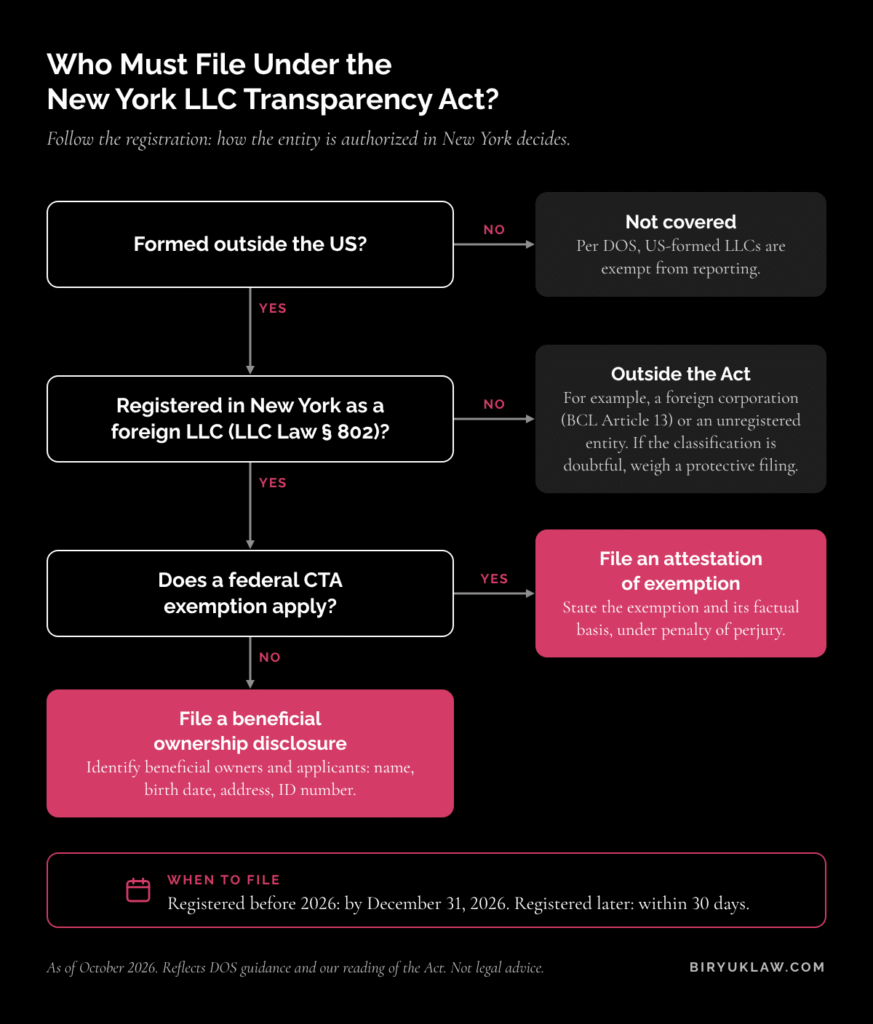
A covered LLC is either a reporting company or an exempt company. A reporting company files a beneficial ownership disclosure. An exempt company files an attestation of exemption, under penalty of perjury, stating “the specific exemption claimed and the facts on which such exemption is based.”
The disclosure must identify each beneficial owner and each applicant by full legal name, date of birth, current home or business street address, and a unique identifying number from an unexpired passport, driver’s license, or government-issued identification document. Unlike the federal regime, New York offers no equivalent of the FinCEN identifier.
Deadlines
An LLC that obtains authority on or after January 1, 2026 must file within 30 days. An LLC authorized earlier must file “within one year of the effective date of this section.” DOS reads that phrase as “by December 31, 2026.” Some commentators read it as January 1, 2027. Filing by December 31 satisfies both readings.
After the initial filing, reporting companies and exempt companies alike must file annual statements confirming or updating their information. DOS’s FAQs confirm the annual requirement but do not yet give a due date.
Mechanics
The statute requires electronic filing. DOS’s FAQs refer to a “secure filing system.” But DOS’s filing page still reads “SUBMISSION PORTAL COMING SOON.” For now, filers email the PDF form, with a card authorization for the $25 fee, to [email protected]. DOS asks filers not to use mail or fax.
Confidentiality and Penalties
The information goes into a secure, confidential database, which DOS says is exempt from the Freedom of Information Law. The penalties are real: “past due” status after 30 days, fines of up to $500 per day, suspension of the right to do business in New York, and, for a delinquent foreign LLC, possible annulment of its authority.
What Counts as an LLC?
This is the hardest question, and neither the statute nor DOS’s guidance answers it. It matters most to lawyers with cross-border clients. A German GmbH, a French SARL, a Polish sp. z o.o., a Ukrainian TOV, and an English private limited company all look like LLCs to an American eye. Are they “limited liability companies” under the Act?
Labels Do Not Decide
Many of these forms are legal persons under their home law. A GmbH holds its own rights and obligations, and only its assets answer for its debts. An English private company becomes a body corporate on registration. But a New York LLC is also “a separate legal entity.” Legal personality cannot be the test.
Federal tax law shows how misleading labels can be. Its list of “per se” corporations includes the German Aktiengesellschaft, the Polish Spolka Akcyjna, the Ukrainian Aktsionerne Tovaristvo Vidkritogo Tipu, and the UK public limited company. It omits the GmbH, the sp. z o.o., the TOV, and the UK private limited company. Those are “eligible entities” that default to association status when all members have limited liability, unless they elect otherwise. Tax classification is persuasive at most. But it shows that US law sorts foreign entities by purpose-specific rules, not by name.
New York’s Text Points to the Registration Pathway
The Act limits reporting companies to “limited liability companies formed or authorized to do business in New York state.” For a non-US entity, that means a “foreign limited liability company.” The LLC Law defines that term as “an unincorporated organization formed under the laws of any jurisdiction,” including a foreign country, “that is not authorized to do business in this state under any other law of this state,” and whose members have limited liability.
Two consequences follow.
First, an entity authorized as a foreign corporation falls outside that definition by its own terms. “A foreign corporation shall not do business in this state until it has been authorized to do so” under Article 13 of the Business Corporation Law. An entity holding that authority is authorized “under any other law of this state.” It is not a foreign LLC, and the Act does not reach it.
Second, an entity that applied for authority under section 802 of the LLC Law did so as a foreign LLC. It is presumptively within the Act.
Working Rule
The most defensible rule, then, is to follow the registration. Pull the entity’s filing receipt and DOS record. If it holds authority under LLC Law section 802, treat it as covered and decide between a disclosure and an attestation. If it holds authority under Business Corporation Law Article 13, treat it as outside the Act. Where the original classification looks doubtful, weigh the modest cost of a protective filing against the penalty exposure.
For an entity not yet registered, the choice of pathway should follow the entity’s actual characteristics. That choice now carries a reporting consequence, so document the basis for it.
Gray Zones
US Beneficial Owners
DOS says reporting companies need not report owners who are US persons. Federal law says the same. But the route matters. New York borrows the federal definition of “beneficial owner.” FinCEN’s carve-out for US persons is not part of that definition. The final rule moved it out of the beneficial-owner paragraph and into a separate “special exemptions” paragraph. Read literally, then, New York’s definition still includes US persons, and the statute requires the disclosure to identify every beneficial owner.
DOS’s position is the practical answer, and filers may reasonably rely on it. But it rests on FAQs, not regulations, and the FAQs reflect the law in effect on December 23, 2025. The Secretary of State has authority to adopt regulations. A rule would settle the point.
The FAQs also use two different terms. One answer speaks of “U.S. persons.” Another says the filing “is only to be used to disclose the personal details of non-US citizens.” The terms are not interchangeable. Under the federal rule, “United States person” carries its Internal Revenue Code meaning, which includes resident aliens. A lawful permanent resident is therefore a US person but not a US citizen. Until DOS reconciles its answers, disclosing such owners is the cautious course.
Foreign LLCs Owned Entirely by US Persons
Under federal law, such a company still files a report; it simply lists no beneficial owners. DOS has not said whether the company should file a disclosure listing no individuals or an attestation of exemption. One could read the regime to call for an attestation instead. But ownership by US persons is not among the CTA’s listed exemptions, so an attestation would have no “specific exemption” to claim. The better course is a disclosure that identifies no reportable individuals, with the basis explained in the transmittal email.
Applicants
New York requires each applicant to be identified. For an authorized foreign LLC, DOS treats the applicant as the individual who directly filed the document that first registered the company with DOS. Two problems follow. First, the federal rule spares companies formed or registered before 2024 from reporting company applicants; New York has no such cutoff, so older registrations may require some digging. Second, FinCEN’s relief for US-person applicants is, again, an exemption rather than a change in definition. DOS’s “non-US citizens” answer suggests that US-citizen applicants need not be reported. A rule should confirm it.
Exempt-Company Cross-Reference
One drafting wrinkle cuts the other way. An “exempt company” is an LLC that is not a reporting company but “meets a condition for exemption enumerated in 31 U.S.C. § 5336(a)(11)(B).” FinCEN excluded domestic entities under clause (xxiv) of that very list. Read literally, every New York LLC—and every LLC from another state authorized here—could be an exempt company obliged to file an attestation. DOS has not read the statute that way; its FAQs treat US-formed LLCs as “exempt from reporting requirements.” That answer is sensible, but it is another point a rule should resolve.
Moving Target
Because New York borrows federal definitions “as amended,” its Act will expand or contract whenever FinCEN changes course. A future federal rule restoring domestic reporting could revive New York’s domestic coverage without any action in Albany. Practitioners should watch Washington as closely as Albany.
What Still Applies to Foreign-Owned US LLCs
Many foreign entrepreneurs own a Delaware, Wyoming, or New York LLC rather than a foreign entity. For them, beneficial ownership reporting is gone, both federally and in New York. But transparency did not disappear. It moved. For the federal picture, see our BOI reporting guide.
Banks
Under the Customer Due Diligence (CDD) Rule, covered financial institutions must maintain procedures “reasonably designed to identify and verify beneficial owners of legal entity customers,” using a 25-percent ownership prong and a control prong. The final rule leaves the CDD Rule in place, although FinCEN says it “is still legally required to modify” that rule. Clients should expect banks to keep asking.
IRS
A single-member US LLC wholly owned by a foreign person is disregarded for most federal tax purposes. For purposes of section 6038A of the Internal Revenue Code, however, it is treated as a corporation. It must file Form 5472, and the small-corporation and de minimis exceptions do not apply. The penalty for failure is $25,000 per taxable year, plus $25,000 for each 30-day period that the failure continues more than 90 days after IRS notice.
New York
A New York LLC must publish notice of its formation within 120 days—once a week for six successive weeks, in two newspapers designated by the county clerk—or its authority to do business is suspended. A foreign LLC authorized in New York faces the same requirement.
Practitioner Checklist
- Inventory. List every client entity formed outside the United States that does business in New York.
- Confirm pathway. Pull each entity’s DOS record and filing receipt. Note whether it holds authority under LLC Law section 802 or Business Corporation Law Article 13.
- Screen for exemptions. For each section 802 entity, test the CTA exemptions. If one applies, prepare an attestation stating the exemption and the supporting facts.
- Map ownership. Otherwise, trace the ownership chain to every individual who owns or controls at least 25 percent or exercises substantial control. Mark each as a US citizen, another US person, or neither.
- Identify applicants. Find the individual(s) who filed the application for authority.
- Collect identification. Gather each reportable individual’s name, date of birth, address, and unexpired identification number.
- File early. Email the form and fee authorization to DOS well before December 31, 2026 and keep proof of transmission.
- Cure 2026 gaps. For entities authorized during 2026, confirm that the 30-day filing was made. If not, file now.
- Calendar annual statements. Monitor DOS for the portal, a due date, and any regulations.
- Remind US-entity clients. Foreign-owned US LLCs still face bank due diligence, Form 5472, and New York publication.
Conclusion
The New York LLC Transparency Act is no longer the sweeping regime its text suggests. It is a narrow filing obligation for non-US LLCs, defined by federal rules that New York does not control. Narrow, however, is not simple. Until DOS adopts regulations, practitioners should file early, follow the registration pathway to decide what counts as an LLC, and resolve doubts in favor of disclosure. The first deadline is December 31, 2026.
Solution
Is your company registered in New York but formed abroad?
We can confirm whether it must file under the New York LLC Transparency Act, which filing applies, and help prepare it before the deadline of December 31, 2026. To this end, see our US business services or book a consultation.
FAQs
Does the New York LLC Transparency Act apply to my Delaware or New York LLC?
No. Under the Department of State’s current guidance, LLCs formed in New York, another state, or a US territory are exempt from reporting.
Which companies must file under the New York LLC Transparency Act?
Non-exempt LLCs formed under the law of a foreign country and authorized to do business in New York. They file a beneficial ownership disclosure or, if an exemption applies, an attestation of exemption.
What is the deadline?
LLCs authorized in New York before January 1, 2026 must file by December 31, 2026. LLCs authorized later must file within 30 days.
Does a GmbH or a UK private company registered in New York have to file?
It depends on how it registered. In our view, an entity authorized as a foreign LLC under LLC Law section 802 is presumptively covered, while one authorized as a foreign corporation under Business Corporation Law Article 13 is not. Get advice on borderline cases.
What happens if the filing is late?
After 30 days, the LLC shows as “past due” on state records. The Attorney General can impose fines of up to $500 per day, and the LLC can be suspended from doing business in New York until it files.
Sources
New York
- N.Y. Ltd. Liab. Co. Law § 102, § 203, § 206, § 802, § 1106, § 1107, § 1108
- N.Y. Bus. Corp. Law § 1301
- S. 995-B (2023), S. 8059 (2024), S. 8432 (2025, vetoed)
- N.Y. Dep’t of State, Beneficial Owner Disclosure and FAQs
Federal
- 31 U.S.C. § 5336
- FinCEN, interim final rule, 90 Fed. Reg. 13,688 (Mar. 26, 2025)
- FinCEN, final rule, 91 Fed. Reg. 52,508 (Aug. 14, 2026)
- 31 C.F.R. § 1010.380 and § 1010.230
- 26 C.F.R. § 301.7701-2, § 301.7701-3, § 1.6038A-1, § 1.6038A-2
- 26 U.S.C. § 6038A and § 7701
Foreign
Commentary
- Troutman Pepper Locke, From Broad to Barely There (Aug. 19, 2026)
- Cogency Global, New York’s LLC Transparency Act: Important Updates (Feb. 12, 2026)
- Morrison & Foerster, Update—Vetoed: New York’s LLC Transparency Act (Dec. 30, 2025)
- Capitol Services, New York LLC Transparency Act Update (Jan. 7, 2026)


Leave a Reply